
The Speed of War
In high-stakes tactical environments, the speed of decision-making determines survival. This same principle applies to modern sales, recruitment, and business leadership. You are not just negotiating; you are engaging in a battle for influence, authority, and outcome. The battlefield is dynamic, shifting with every objection, every hesitation, and every market fluctuation.
The OODA Loop—Observe, Orient, Decide, Act—is a combat doctrine developed by military strategist John Boyd. It was designed to explain how fighter pilots could gain an advantage over adversaries in chaotic dogfights. In the business world, it is the secret weapon for dominating high-stakes closing scenarios. While the amateur sales rep is still reciting their script, the OODA operator has already analyzed the prospect's hesitation, adjusted their strategy, and moved for the kill.
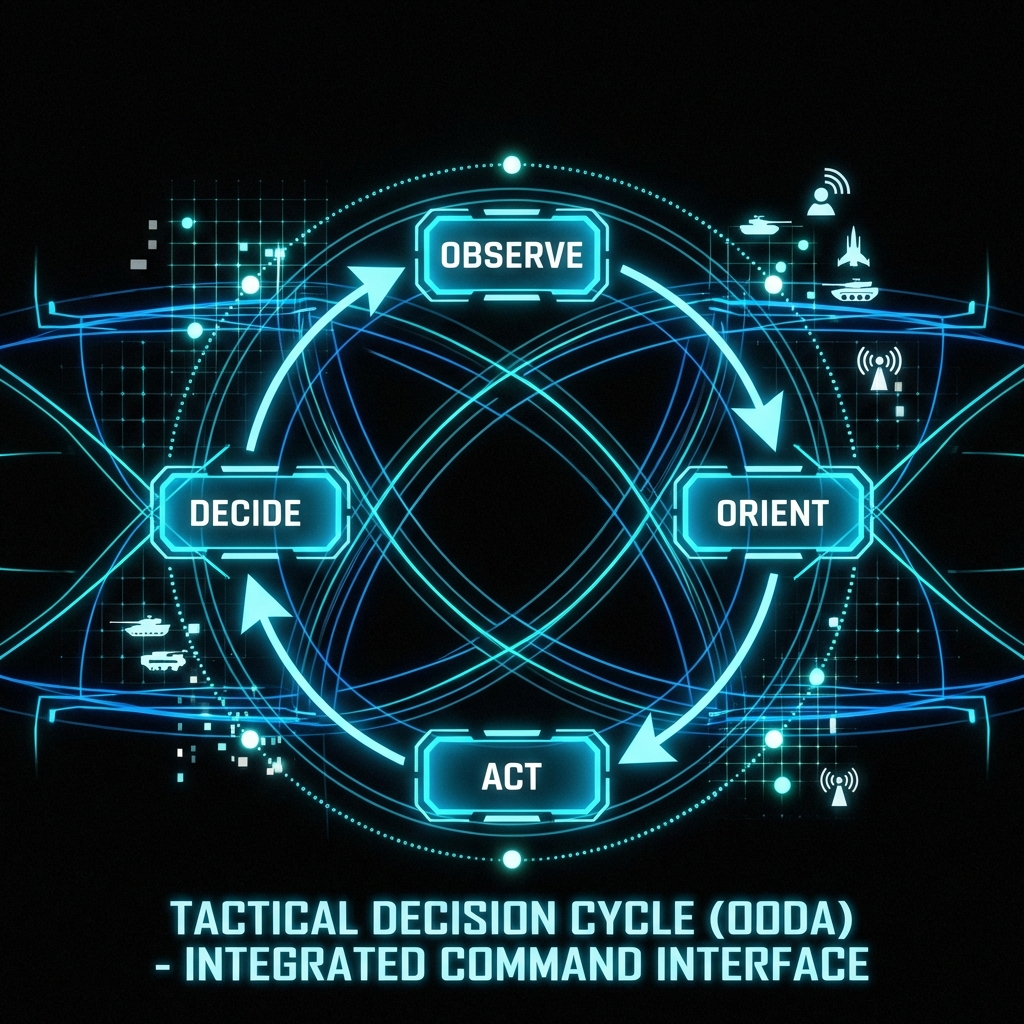
Most salespeople operate on linear scripts. They are predictable. Static. Easy to counter. The OODA Loop operator is dynamic. They process information faster than the prospect can adapt, forcing the "enemy" to react to situations that have already changed. This is how you win. You do not wait for the perfect moment; you create it through the relentless application of speed and psychological pressure.
Phase 1: Observe (Intelligence Gathering)
The first failure point for most sales reps is blindness. They enter a call with a pitch deck and a prayer, completely ignoring the reality on the ground. Observation is the foundation of all tactical success. Without data, you are firing into the dark. Intelligence gathering must happen before, during, and after every engagement.
Beyond the Script
Observation is not passive looking; it is active scanning. In a sales context, you are scanning for micro-signals that reveal the truth behind the facade:
- Unspoken Hesitation: The pause before they answer a question about budget. It reveals uncertainty or lack of authority. A pause of even one second can indicate a hidden objection or a lack of confidence.
- Power Dynamics: Who is actually making the decision? Who is the influencer? Who is the blocker? Watch who they look at when a difficult question is asked. The eyes never lie; they always flick toward the true source of power in the room.
- Environmental Indicators: What is happening in their business sector right now? Are they bleeding cash or flush with capital? Are they in a growth phase or a consolidation phase? Understanding the macro-terrain gives you the advantage in the micro-battle.

Our AI Neural Core handles the preliminary observation by analyzing digital footprints and psychometric data before you even pick up the phone. But once you are live, your eyes and ears must be tuned to a frequency others cannot hear. You must listen to what is not being said.
Phase 2: Orient (The Cultural Filter)
Observation without orientation is just noise. Boyd considered this the most critical step. Orientation is how you interpret the data you just gathered based on your genetic heritage, cultural tradition, and previous field experience. It is the software that processes the raw data from your sensors.
"Orientation creates the lens through which we view the world. If your lens is cracked, your decisions will be flawed."
You must filter your observations through the context of your prospect's reality. If you observe that a CEO is highly risk-averse (Guardian Personality Type), you cannot orient your pitch around "disruption" or "revolution." That language triggers their threat response. You will lose the deal before you have even stated your price.
Shifting the Frame
Instead, you must Orient your solution as a "stabilization mechanism" or "risk mitigation protocol." You are taking the same product but framing it through a lens that matches their cognitive bias. This alignment creates crucial trust and lowers resistance buffers. You are speaking their dialect, not just their language.
Disorientation in your opponent leads to their collapse. If you can change the context (Orient) faster than they can, their mental model of the world becomes obsolete. They become confused, and in their confusion, they look to you for leadership. You become the anchor in their storm.
Phase 3: Decide (Hypothesis Selection)
Analysis paralysis is the enemy of execution. In combat, a good decision made immediately is superior to a perfect decision made too late. The market does not reward perfection; it rewards speed and precision. You cannot wait for 100% certainty; 70% is enough to move.

Based on your Orientation, you must choose a single course of action. Do not waver. The "maybe" kills deals. You must decide:
- Attack: Press the advantage on their pain point. If they reveal a weakness, exploit it to show the necessity of your solution. Do not be polite; be effective.
- Defend: Handle an objection and pivot. Reframe their concern as a misunderstanding or a feature, not a bug. Turn their shield into your weapon.
- Retreat: Disqualify the lead and end the call to preserve time assets. Walking away is a powerful negotiation tactic and a necessary time-management skill. Your time is the only non-renewable resource you have.
The operative word here is Decide. Taking ownership of the interaction means you are driving the vehicle, not just riding in the passenger seat. You must accept the risk of being wrong to gain the reward of being right.
Phase 4: Act (Violence of Execution)
Once the decision is made, execute with absolute conviction. Violence of action does not mean aggression; it means intensity and intent. It means moving without hesitation, with full force and commitment.
If you decide to close, you close. You do not ask, "So, what do you think?" You say, "Based on what you've told me, the only logical next step is to initiate the protocol. I'm sending the agreement now—let's get this signed so we can deploy resources." This is the command mindset.
Closing the Loop
The action must be decisive enough to shatter the prospect's OODA loop. By the time they process your move, you are already cycling back to Observe to see how they react. Did they flinch? Did they sign? Did they object? The loop never stops; it only resets.
This continuous cycle—Observe, Orient, Decide, Act—creates a rhythm that the prospect cannot match. You become the pacing element of the interaction. You control the heartbeat of the deal.
Controlling Tempo
The ultimate goal is to cycle through your OODA loop faster than your opponent. If you can Observe, Orient, Decide, and Act before they have even finished Orienting on your last move, you are effectively operating in their future.

This causes confusion and disorientation in the prospect. In this state, they look for a leader. They look for someone who has clarity. That leader is you.
Tempo is not just speed; it is rhythmic pressure. Like a boxer who controls the pace of the fight, you must dictate when to accelerate and when to pull back. This creates a psychological dependency where the prospect begins to wait for your next move rather than formulating their own strategy.
Common Tactical Errors
Even elite operators make mistakes when first implementing the OODA Loop. Here are the most common failure modes:
Error 1: Observation Without Action
Some operators become addicted to data collection. They observe endlessly but never move to the Decision phase. This is academic paralysis. Remember: in combat, the second-best plan executed NOW is superior to the best plan executed too late. Set observation time limits. Force yourself to decide.
Error 2: Skipping Orientation
This is the opposite problem. The operator observes and immediately acts without interpreting the data through the prospect's cultural lens. This leads to tone-deaf pitches that trigger resistance. Always pause to Orient. Ask yourself: "What does this data mean in THEIR world?"
Error 3: Weak Execution
The operator makes a decision but executes with hesitation. This broadcasts uncertainty. The prospect smells blood and attacks. When you Act, you must Act with conviction. Even if you are uncertain internally, externally you must project absolute confidence. This is not lying; this is leadership.
Integration Protocol
Theory without practice is useless. Here is your 30-day integration protocol for mastering the OODA Loop:
Week 1: Observation Training
Record 10 sales calls. Transcribe them. Identify 5 micro-signals you missed in real-time. Train your pattern recognition. What verbal tics indicate hesitation? What questions trigger defensive posture? Build your signal database.
Week 2: Orientation Drills
Before every call, spend 5 minutes researching the prospect's personality type. Use DISC, Enneagram, or any framework you prefer. Write down 3 potential frames that would resonate with their type. Practice shifting frames mid-conversation.
Week 3: Decision Speed
Set a timer for 30 seconds. When an objection arises, you have 30 seconds to decide your tactical response: Attack, Defend, or Retreat. No more. This trains your decisiveness muscle. Speed beats perfection.
Week 4: Execution Intensity
Practice closing with violence of action. Record yourself delivering closing statements. Watch the playback. Do you sound like a leader or a supplicant? Adjust your tonality, pacing, and word choice until you embody command presence.
Master the loop. Control the tempo. Dominate the outcome. This is the way of the operator.